


 Written by
 To go with my “48 Hours in Bucharest” article in the Independent, here’s a blog post about Ceausescu’s grand folly: the Parliament palace in Bucharest.
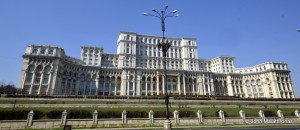
The Bucharest Parliament Palace
I joined a public tour to see the parliament (you need to bring your passport or national ID card) and after one hour and 1.5 kms of walks I had still only seen less than 10% of it. The building was completed in 1994 and, since 1996, it houses the Romanian Senate and Chamber of Deputies; the ground floor is home to a Modern Art museum. And it’s still 70% empty.
How did this monster come to be?
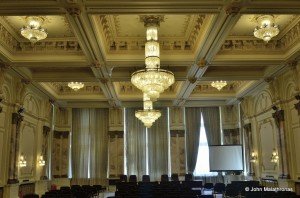
Just another meeting room.
My guide, Irene, told me the story.
“Ceausescu took advantage of a 1977 earthquake to flatten the old town south of the rer. He wanted to rebuild it in his own image. Everything in an area of four square miles was rebuilt from scratch to match the style of the People’s Palace. In Bucharest 40,000 people were forcibly displaced. A stadium, hospitals and 27 churches and synagogues were demolished. Only three churches were saved which were moved to behind large apartment blocks so as to remain invisible.”
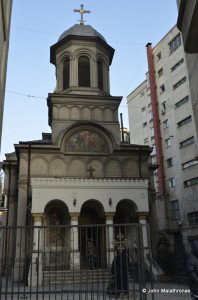
The church of St John the New which was moved to behind a block of flats
To everyone’s surprise, Ceausescu chose an unknown young woman to mastermind his plan. She was Anca Petrescu. Although she’d only graduated from Bucharest Uni in 1973 and although she failed to make the shortlist, she built a super ornate model of the buildings and insisted on presenting it to Ceausescu herself. Her persistence, sheer willpower and, some say, hold she had on the dictator, paid off.
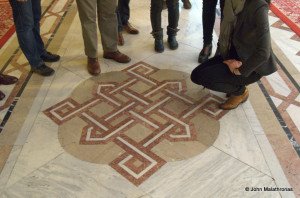
The tiles of every floor are decorated with a pattern which is the plan of the building.
“She was the head of 700 architects, 20,000 building workers doing 3 shifts a day plus 5,000 army personnel, 1.5 million people in factories, plus an unknown numbers of pensioners and ‘volunteers’. Even nuns in the monastery of Agapia in Bucovina hand-embroidered the large silk window drapes in the main Union Hall,” Irene says.
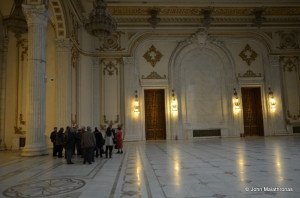
The massive Union Hall
To build the palace Ceausescu flattened a hill in Bucharest and changed the course of the Tambovita river. He also insisted that only Romanian products and labour would be used to build the palace and as a result cut down oak forests for timber in an advanced rate, resulting in the rapid deforestation of the countryside.
Irene gives us some numbers. “In volume it is the third largest building in the world after the Aztec pyramid of Teotihuacan near Mexico City and the Cape Canaveral building where they assemble space rockets. In terms of area (365,000 sqm) it is the second largest after the Pentagon. It uses 220,000 sqm of carpet. 3,500 tons of crystal and 1 million cubic metres of marble. The carpet in the Union Hall alone weights 1.5 metric tons”.
She claps her hands. The sound travels crisply. Every chamber has perfect echo because when Ceausescu wanted something he clapped and he wanted everyone to KNOW he clapped.
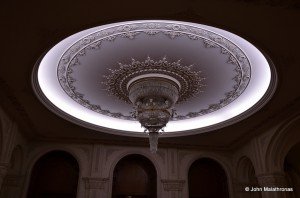
One of many crystal chandeliers.
“Even though the main chamber has many floors built above it, there are fake French skylights with neon lights above, giving the impression that rooms are open to the sky” she says.
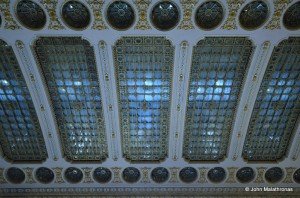
One of the false skylights. There are several floors above it.
Ceausescu had a private theatre built inside the palace (the last visitor before me to give a speech there was Vladimir Putin) as well as two large spiral staircases that come down to the main hall: Ceausescu and his wife Elena would step down in sync to make a grand appearance.
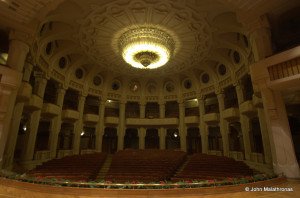
Ceausescu’s private theatre
“He had the staircases rebuilt twice because they did not match his step,” says Irene. “He was short and touchy about his height.”
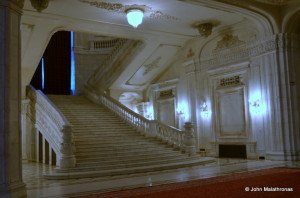
Ceasuescu’s rebuilt staircase to match his step.
Ceausescu never got to see the building finished. When, after the 1989 December revolution, he was tried and shot along with his wife, the building was only two-thirds complete. The incoming administration didn’t know what to do with it but the Romanian economy was so entangled with the People’s Palace – now the Parliament Palace – that they had to finish it. Running costs are still a dizzying £3.8 million a year.
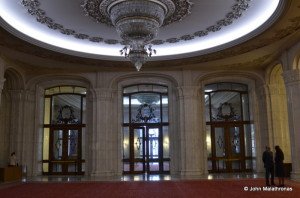
The main entrance
Some tried to put Anca Petrescu on trial, but judges agreed there was no case to answer. She left for France in the 1990s and built several Club Med resorts instead. She returned in 2002 when modifications to the building were planned and supervised the addition of a cupola. She entered parliament in 2004 as part of the list of the nationalist Greater Romania party. She died in a road accident on 30 October 2013.
But when she put her name down as a candidate for Bucharest mayor in 2004, she won less than 4% of the vote.
Frankly, that says it all.

